Contents
A client comes to us with an app built by another provider. Sometimes because that provider disappeared, sometimes because the relationship broke down, and sometimes simply because they want a second opinion before investing more money in a product whose real condition they do not know.
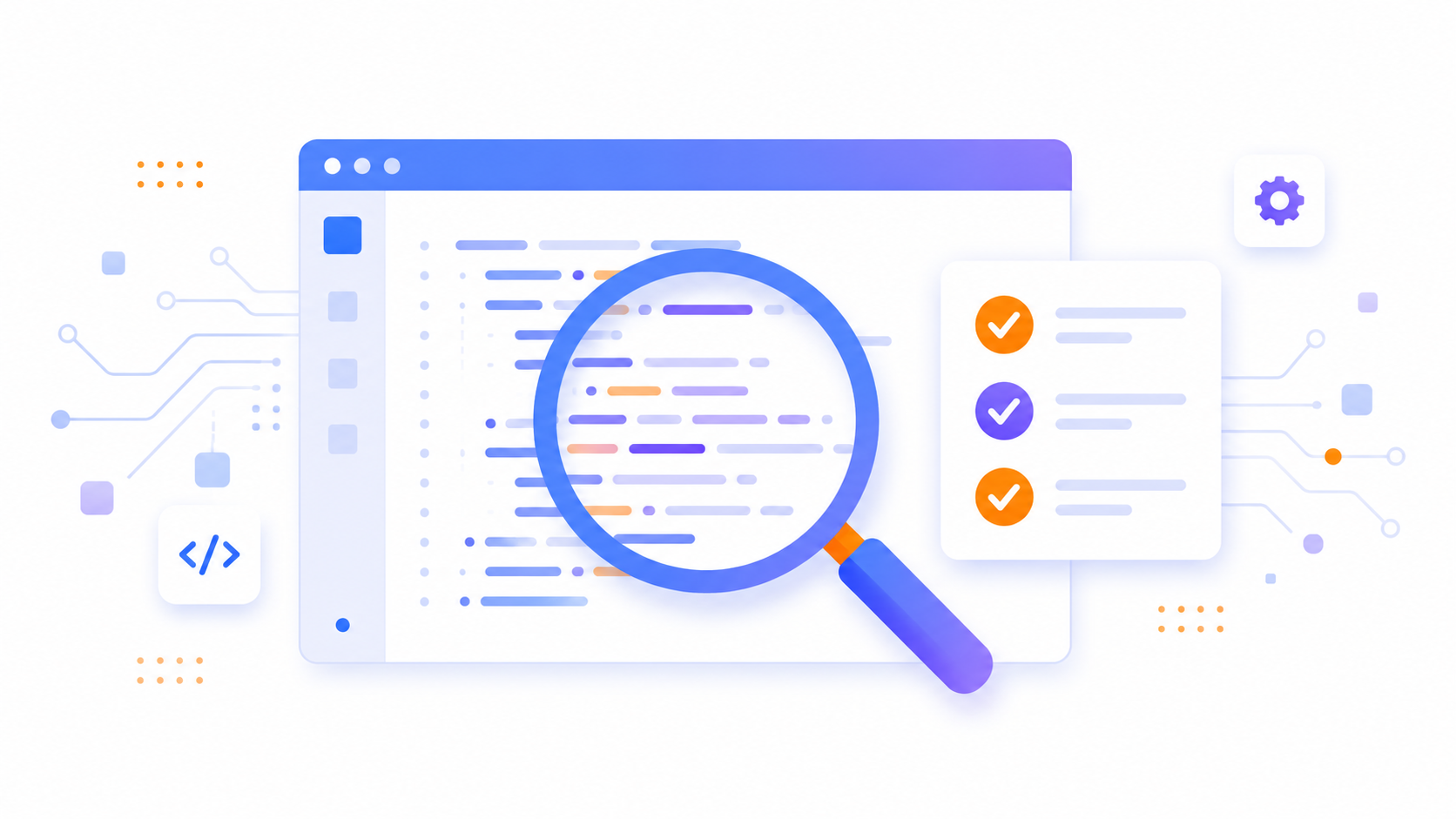
In all these cases, the first thing we do is a technical audit. Not to prove that the previous work was bad, but to understand exactly what we are working with: what functions correctly, what is fragile, what is generating technical debt, and what could become a serious problem if left unaddressed.
This article explains how we structure that process and what we typically find.
The first thing we review is how the code is organised at a global level. This includes the separation of layers (frontend, backend, database), how development and production environments are managed, and whether any technical documentation exists explaining the design decisions.
A well-structured project is a maintainable project. When the architecture is chaotic, every future change costs twice as much and the risk of accidentally breaking something multiplies.
Common warning signs at this stage:
All code in a single file or unstructured repository.
Business logic mixed with presentation code.
Configuration variables hardcoded in the source code.
No separate testing environment from production.
We review the source code to assess its real quality: style consistency, use of design patterns, complexity level, and how easy it is to understand what each part does.
Unreadable code is not just an aesthetic problem. It is a cost multiplier: any new developer needs twice as long to understand it, and the risk of introducing bugs when modifying it is significantly higher.
We also check whether test coverage exists. In most inherited projects, it does not. That is not always a critical problem, but it does affect how safely the product can be evolved going forward.
The database is frequently where the most costly problems to fix are hiding. We review the data schema, model consistency, index usage, and the presence of queries that could degrade performance as the system scales.
Common issues we find:
Tables without properly defined primary keys.
Missing indexes on columns used as frequent filters.
Relationships between tables without referential integrity.
Critical data stored in plain text without encryption.
Queries that retrieve an entire table when only a few records are needed.
A poorly designed database rarely causes problems with a small number of users. But when volume grows, issues appear suddenly and are difficult to resolve without deep interventions.
Security is the area that most often delivers unpleasant surprises. Not because projects are intentionally insecure, but because under delivery pressure, security controls are the first to be skipped.
We review the most critical points:
Authentication and authorisation: how access is managed and whether permissions are correctly implemented in the backend, not just the frontend.
Sensitive data exposure: whether personal, financial, or confidential information is transmitted or stored without adequate protection.
Input validation: whether the application correctly validates incoming data, or whether it is vulnerable to SQL injection or XSS attacks.
Dependencies with known vulnerabilities: outdated libraries with documented public CVEs.
Secrets in the repository: API keys, credentials, or tokens exposed in the commit history.
This is the area where we most frequently find problems that require immediate action before any other consideration.
We audit how the application is deployed: which hosting provider is used, whether redundancy exists, how backups are managed, and whether the deployment process is manual or automated.
An app without an automated deployment process (CI/CD) depends on a specific person to update it. If that person is unavailable, the process stops. And an app without verified backups does not actually have backups; it has the illusion of having them.
We also evaluate infrastructure costs. In inherited projects it is common to find over-provisioned resources being paid for unnecessarily, or configurations that would work equally well at half the cost.
We analyse load times, API response under normal load, and how the application behaves when multiple users access it simultaneously. This includes a frontend review: asset size, caching, image optimisation, and behaviour on mobile devices.
A slow app is not just a poor user experience. It is an app that loses conversions, creates unnecessary friction, and communicates a careless product image.
Every application carries technical debt. The goal of the audit is not to eliminate it, but to quantify and prioritise it. At the end of the process, we deliver a classification of findings across three levels:
Critical: issues that must be resolved before moving forward. Generally related to security or stability.
Important: issues that do not block current functionality, but that increase the cost and risk of every future change.
Improvements: optimisations that would improve performance, maintainability, or user experience, but that can be planned without urgency.
With this classification, the client can make informed decisions about whether to refactor, migrate, or rebuild parts of the system.
The audit is not an end in itself. It is the starting point for making decisions with confidence: whether it is worth continuing to build on the existing foundation, what needs to be addressed before scaling, or whether it makes more sense to rethink the architecture from scratch.
In some cases, the conclusion is that the product is in better shape than expected and that addressing a few critical points is sufficient. In others, the audit confirms that continuing to invest in the current direction is throwing money away.
Either way, it is information worth having before committing more budget.
It depends on the size and complexity of the project. For a medium-sized application, the complete process typically takes between 3 and 7 business days. Larger projects or those with multiple modules may require more time.
The minimum is access to the source code (repository) and access to a staging or production environment. With existing technical documentation and database access the analysis is more complete, but these are not always available.
No. An audit identifies known issues and detectable risks at that point in time. What it does provide is a much stronger decision-making foundation than working without any prior diagnosis.
When resuming a project after a period of abandonment, when changing development providers, before scaling a product that has grown without planning, or when performance or stability problems appear without a clear cause.
An audit is a diagnosis: it analyses the current state without any commitment to build anything. A development proposal starts from known requirements and estimates future work. The audit is typically the step prior to a proposal when working with inherited code.
Our clients' satisfaction is our best introduction.
"Tengo un negocio de Paquetería, en el que vienen muchas personas diariamente, tanto para recoger como para dejar paquetes. Llevábamos años gestionando muchos de nuestros procesos de paquetería de forma manual, y gracias a Blimbur Technologies hemos dado un salto enorme. Nos desarrollaron una app móvil y una web totalmente adaptadas a nuestro flujo de trabajo, con las que ahora tenemos todo automatizado, trazable y mucho más rápido. Ahora, el cliente sabe si tenemos el paquete y al estar todo mucho más organizado, es mucho más rápido y ágil, lo que hace que los clientes vengan y se vayan con otra cara y sin esperas. El trato ha sido impecable y el resultado, todavía mejor. Un equipo serio, técnico y que se implica de verdad."