Client
YourPadel
Year
2025
Sector
Sports
Technologies
Padel gear price comparator aggregating rackets, shoes, and balls from dozens of online stores daily.
The padel sector has grown very fast in Spain, and with it the number of specialized online stores. For buyers, this means scattered information: every store presents product pages differently, prices change constantly, and there's no reliable way to tell whether a discount is genuine. The result is a slow purchase decision based on guesswork rather than data.
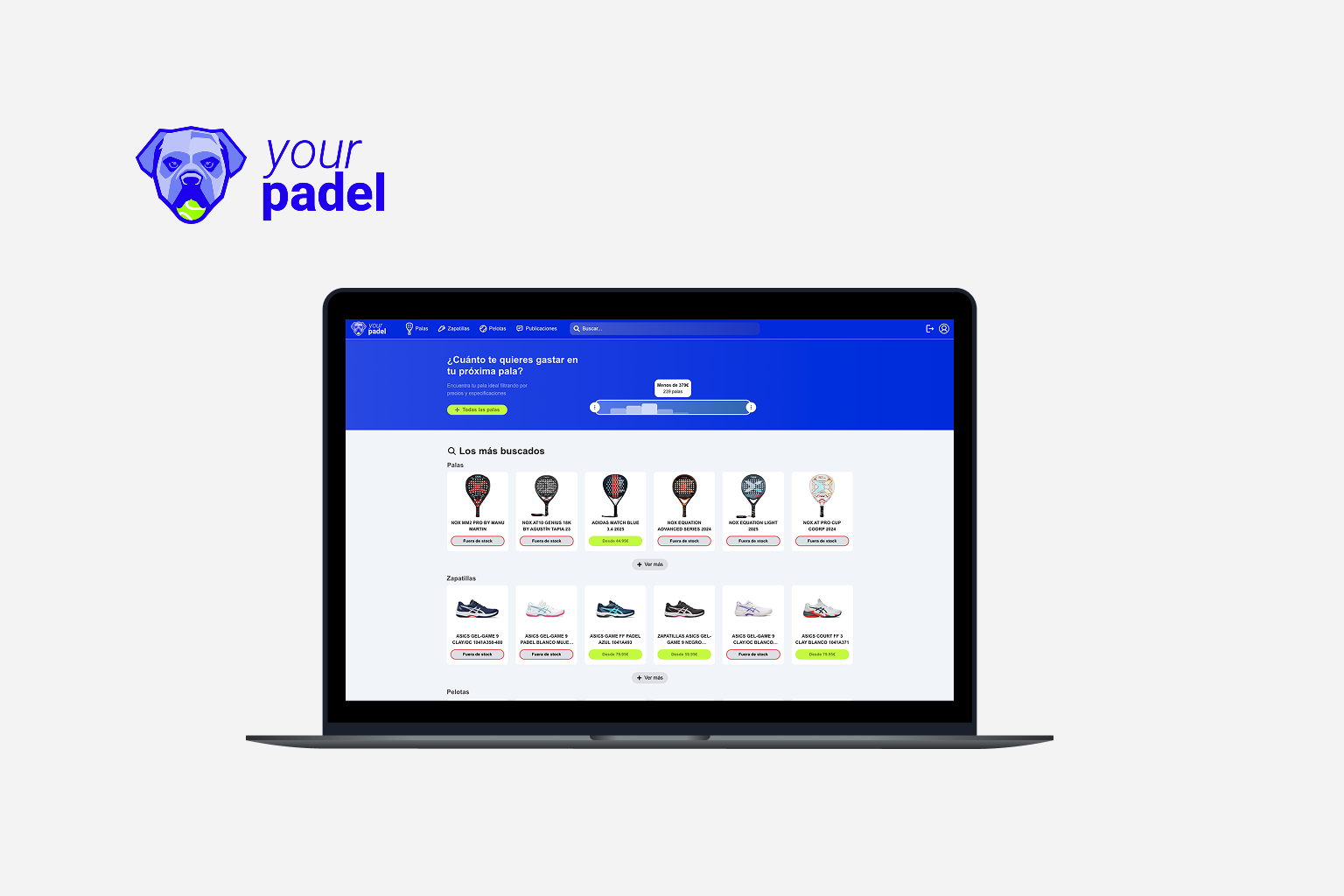
We designed and developed a vertical comparison platform: a unified, normalized catalog, daily price and availability synchronization with reference stores, historical low-price tracking per product, comparable spec sheets across models, and a social feed where users post and comment. As features we can highlight:
Unified catalog: over 200 racket models, 880 shoe models, and 100 ball models, with normalized product pages regardless of the source store.
Daily price synchronization: a proprietary system that updates pricing and availability from reference stores every day, continuously tracking more than 11,000 prices.
Historical low-price tracking: every product page displays the lowest price ever recorded, giving users a real benchmark to decide whether to buy now or wait.
Comparable spec sheets: attributes like shape, balance, core, surface, or playing level are shown consistently across all rackets, making models easy to compare.
Social feed ("Publicaciones"): a space where users post and comment with each other, built to drive community and recurring engagement.
Architecture ready for future monetization (affiliate, advertising, or store leads), with no need to redesign the platform once monetization is activated.
+200 rackets cataloged
+880 shoes cataloged
+100 ball models cataloged
+11,000 prices tracked
+45 leading brands integrated
3 comparable product categories
Historical low-price tracking per product
Daily price synchronization
Normalized spec sheets across stores
Social feed with user posts and comments
With a proprietary scheduled collection process that normalizes each source into a common format before storing it, so a single store's failure doesn't affect the rest of the catalog.
It depends on catalog volume and how many sources need integrating, but the usual approach is to launch first with a smaller catalog and a single source, validate the data model, then scale.
Yes, the data model, sync system, and frontend are decoupled from the sector itself, so the technical foundation is reusable for any catalog with multiple sources.
By defining a single data model per product type (e.g., a racket) and mapping each source to that model, rather than displaying data as-is from each site.
It lets catalog, pricing, and frontend scale independently. If the catalog grows or the sync logic changes, the interface doesn't need to change, and vice versa.
Our clients' satisfaction is our best introduction.
"Tengo un negocio de Paquetería, en el que vienen muchas personas diariamente, tanto para recoger como para dejar paquetes. Llevábamos años gestionando muchos de nuestros procesos de paquetería de forma manual, y gracias a Blimbur Technologies hemos dado un salto enorme. Nos desarrollaron una app móvil y una web totalmente adaptadas a nuestro flujo de trabajo, con las que ahora tenemos todo automatizado, trazable y mucho más rápido. Ahora, el cliente sabe si tenemos el paquete y al estar todo mucho más organizado, es mucho más rápido y ágil, lo que hace que los clientes vengan y se vayan con otra cara y sin esperas. El trato ha sido impecable y el resultado, todavía mejor. Un equipo serio, técnico y que se implica de verdad."