Contents
Some companies have been running custom software for years — functional, apparently stable. Then one day a team member leaves, someone new joins, or there is simply something that hasn't been touched for a while and now needs to be changed. And that's when the real problem surfaces: nobody actually knows how the software works internally.
No documentation. No code comments. No document explaining why certain decisions were made. Just files, and if you're lucky, a developer who vaguely remembers what they built two years ago.
This article is not about best-practice theory. It's about what maintaining undocumented software actually costs a business.
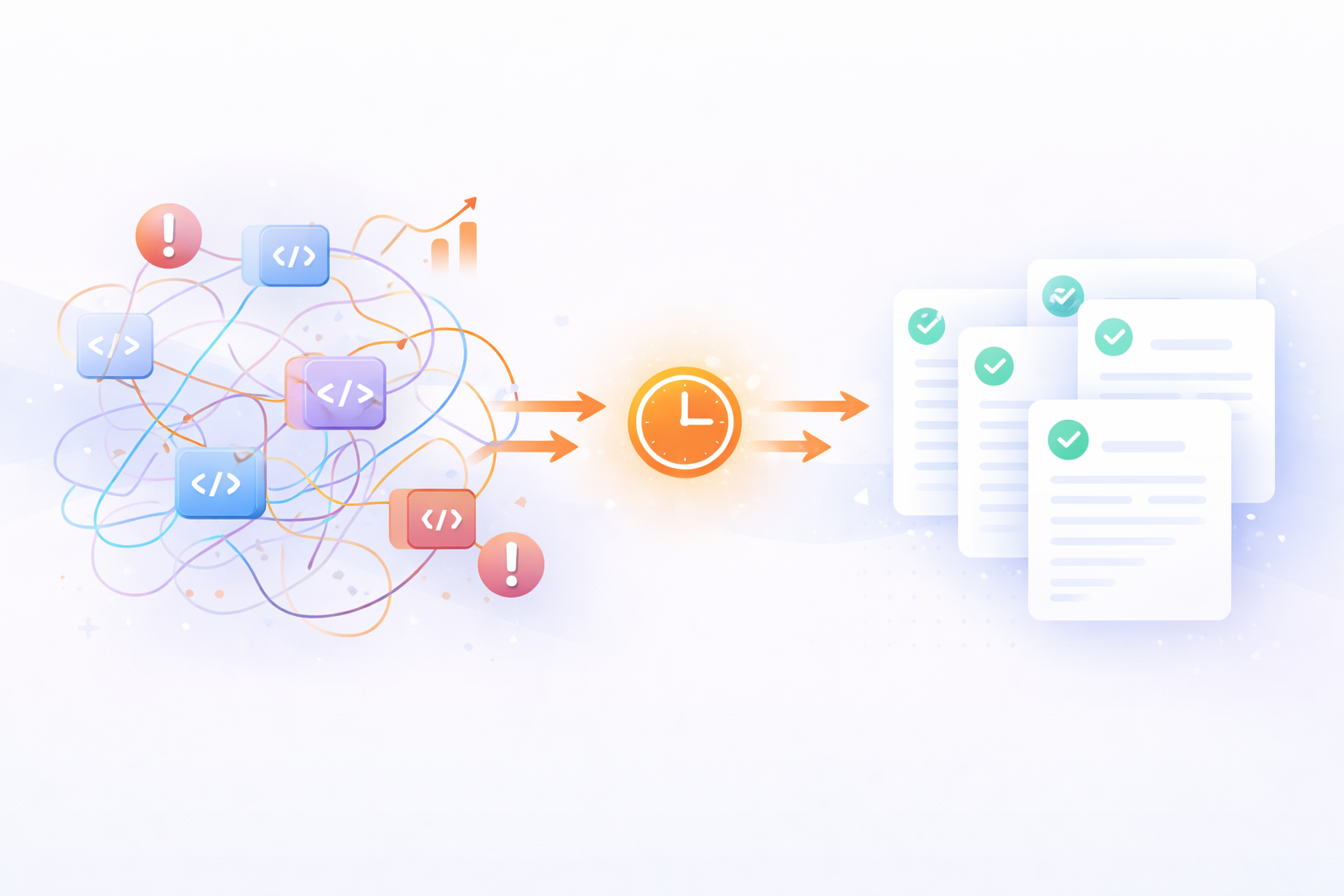
The absence of documentation doesn't break software overnight. What it does is make every intervention more expensive. Whenever something needs to change, the developer has to spend time understanding what exists before they can touch anything.
In well-documented projects, that initial analysis might take an hour or two. In undocumented ones, it can stretch to two or three days. That difference gets billed. Always.
Documentation gaps also increase the risk of breaking things that looked unrelated. A function that seemed independent might be connected to three different modules in ways nobody explained. The developer only finds out when something fails in production.
Exact figures depend on the project, the team, and how long documentation has been neglected. But certain patterns keep repeating:
Onboarding time multiplied: bringing a new developer into an undocumented project can take two to four weeks longer than usual. That time is billed as development hours that produce nothing new.
Inflated maintenance budgets: tasks that should take four hours end up taking twelve because 60% of the time goes into understanding what's there before acting on it.
More expensive bug fixes: without documented context, errors take longer to diagnose. And a bug resolved incorrectly due to missing context tends to generate new ones.
Dependency on specific individuals: when system knowledge lives only in someone's head, that person becomes a single point of failure. When they leave, that knowledge walks out with them.
Over the medium term, the accumulated cost of maintaining undocumented software almost always exceeds what proper documentation would have cost from the start.
Software development uses the term "technical debt" to describe the cost of shortcuts. Missing documentation creates three distinct types of debt worth distinguishing:
Knowledge debt: nobody knows why the system works the way it does. Design decisions are not justified anywhere. When something needs to change, there is no way to know whether that change will break something else.
Time debt: every intervention requires a period of exploration and understanding that would not exist with proper documentation. That time gets billed, and it is not cheap.
Risk debt: without documentation, changes are made with less information. That raises the probability of errors, regressions, and solutions that fix one problem while creating another.
Missing documentation does not hurt equally across all phases of a project. There are moments when it becomes especially critical:
When the technical team changes and knowledge needs to be transferred.
When the project has not been touched significantly in over a year and needs to be picked up again.
When an external provider has to work on someone else's code.
When scaling the system and nobody remembers which parts have limitations.
When there is a critical bug in production and resolution time matters.
In all of these cases, missing documentation turns what should be a controlled process into exploration in the dark.
The most common reason is not laziness. It is pressure. When deadlines are tight and clients want features, documentation feels secondary. The code works, the project moves forward, and documentation is left for later. Later never comes.
There is also a misplaced confidence factor: "we already know how this works." That statement is true until the team changes, or until six months pass and that knowledge fades.
The result is that nearly every mature project carries documentation debt that has to be addressed at some point. The question is whether it gets addressed in a planned way or in the middle of a crisis.
If your software already exists and is undocumented, there is a reasonable path to recovering that debt without freezing development:
Technical audit of the current state: before documenting, you need to understand what's there. An external technical team can review the codebase and map the system's critical components.
Progressive documentation: there is no need to document everything at once. You can start with the modules that get touched most often, the critical business flows, and third-party integrations.
Making documentation part of the process: from a certain point onward, any change or new feature should include documentation as part of the deliverable — not as an extra, but as part of the work itself.
This process has a cost, but it is always lower than continuing to maintain an opaque system that becomes more expensive to touch with every passing month.
Properly documenting an ongoing project typically adds between 10% and 20% to the initial development time. It is an investment with a direct return: fewer analysis hours per maintenance cycle, lower risk of errors, and teams that can rotate without losing critical knowledge.
Not documenting carries an invisible cost at first — one that becomes very visible the moment something urgent needs to change and nobody quite knows where to start.
The decision is not whether to document. It is whether to pay that cost in a controlled way or wait and pay it with interest.
If you have software that needs maintenance and you want to understand its current state and what it would take to bring it into order, we can carry out a no-commitment review.
Tell us about your situation and we will tell you what we would find and how we would approach it.
Because every intervention requires an upfront analysis period to understand how the system works before anything can be changed. In well-documented projects that analysis might take a few hours; in undocumented ones, it can take two or three days. That extra time gets billed every time and repeats with every maintenance cycle.
Missing documentation generates three types of accumulated debt: knowledge debt (nobody knows why the system works the way it does), time debt (every change requires prior exploration), and risk debt (changes are made with less information and a higher probability of error). The longer documentation is neglected, the more expensive it becomes to address.
The most critical moments are: when the technical team changes and knowledge needs to be transferred, when the project has not been touched for a while and needs to be picked up again, when an external provider has to work on the codebase, when the system needs to scale, or when a serious production bug occurs and resolution time is critical.
The most practical path involves three steps: first, a technical audit that maps the real state of the system; second, progressive documentation starting with the most critical modules and third-party integrations; and third, making documentation a mandatory part of any future change or development. It does not need to happen all at once.
Documenting a project properly during development typically adds between 10% and 20% to the total time. It is an investment with a direct return: it reduces analysis hours in every subsequent maintenance cycle, lowers the risk of errors, and allows the technical team to rotate without losing the accumulated knowledge of the system.
Our clients' satisfaction is our best introduction.
"Tengo un negocio de Paquetería, en el que vienen muchas personas diariamente, tanto para recoger como para dejar paquetes. Llevábamos años gestionando muchos de nuestros procesos de paquetería de forma manual, y gracias a Blimbur Technologies hemos dado un salto enorme. Nos desarrollaron una app móvil y una web totalmente adaptadas a nuestro flujo de trabajo, con las que ahora tenemos todo automatizado, trazable y mucho más rápido. Ahora, el cliente sabe si tenemos el paquete y al estar todo mucho más organizado, es mucho más rápido y ágil, lo que hace que los clientes vengan y se vayan con otra cara y sin esperas. El trato ha sido impecable y el resultado, todavía mejor. Un equipo serio, técnico y que se implica de verdad."