Contents
You have an idea. You know it solves a real problem. You even have a clear picture of who your user is. But the moment you try to take the first step, you hit a wall: do I talk to a designer or a developer? Do I need to set up a company first? What does this actually cost?
That paralysis is far more common than people admit. And the problem is almost never the idea itself. It is that nobody has given you a clear roadmap for turning it into a real product.
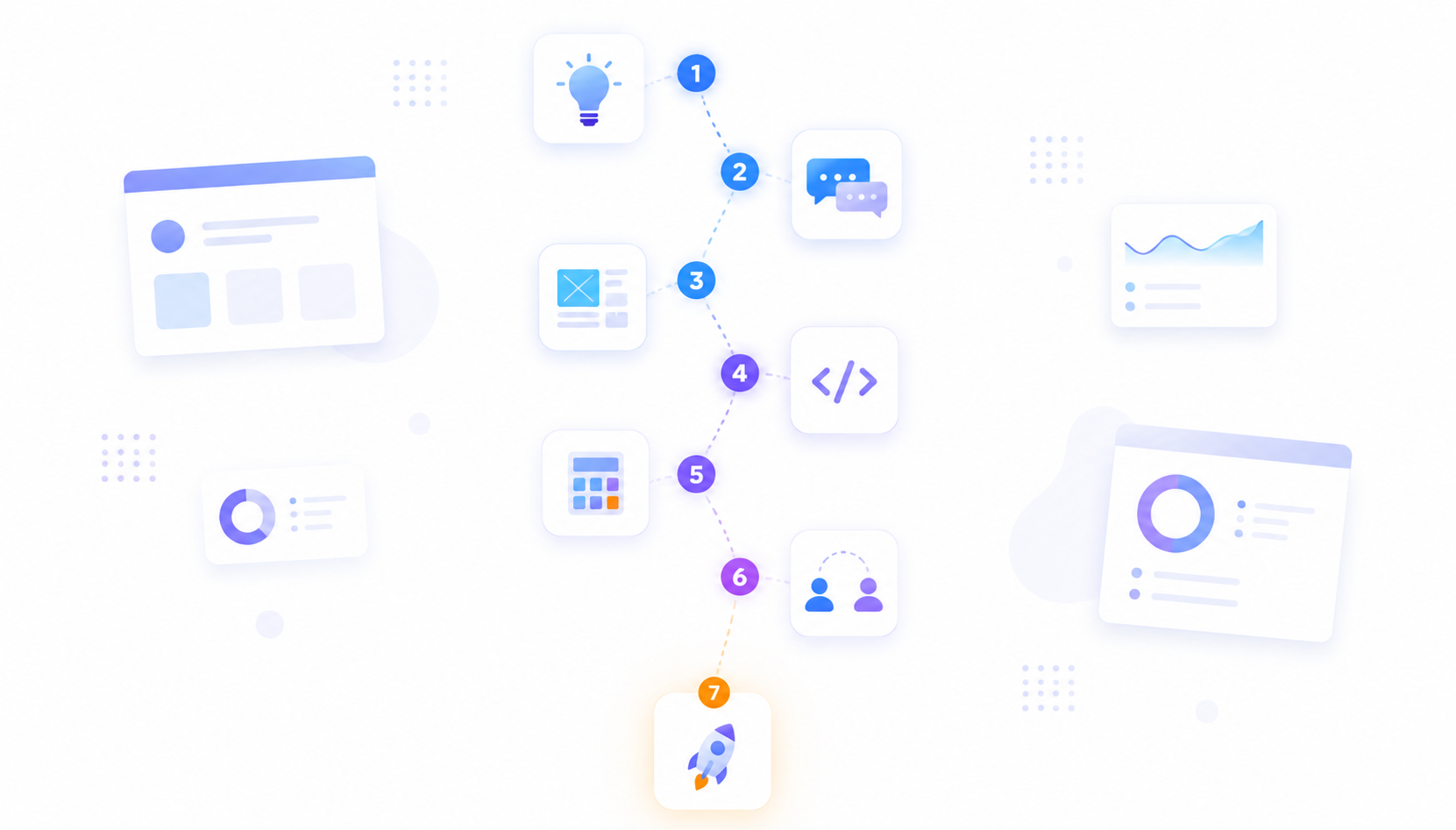
This article is exactly that: a step-by-step guide from the moment you have an idea to the moment you have a working product in the hands of your first users. No unnecessary jargon, no detours.
The most common mistake when building an app is starting with features. “I want an app with a chat, a map, user profiles, ratings, and a payment system.” Fine. But what for?
Before thinking about technology, you need to be able to answer these questions precisely:
What specific problem does your app solve?
Who experiences it, and how often?
How does that person solve it today, even imperfectly?
Why is your solution better than what already exists?
If you cannot answer these clearly, you are not ready to build yet. You need to validate first. And validation does not mean spending money: it means talking to real people who actually have that problem.
Validation is the step most people skip and the one that saves the most money. Before investing in development, you need to confirm that the problem is real, that there are people willing to pay for a solution, and that your approach makes sense.
Interviews with potential users: talk to 10 to 15 people from your target audience. Do not ask them if they would like your app; probe them on how they solve the problem today.
Landing page with a waiting list: describe the problem and the solution, add a contact form, and measure whether anyone signs up.
Clickable prototype: tools like Figma let you simulate app flows without writing any code. You can put it in front of real users and watch how they interact.
Manual operation: in some business models it is possible to deliver the service manually before automating it. It is slow, but it validates real demand.
If the idea holds up after validation, then investing in development makes sense.
An MVP (Minimum Viable Product) is not a cheap version of your full app. It is the smallest possible version that demonstrates the core value of your product with real users.
To define it well, write down every feature you think your app needs. Then remove everything that is not strictly necessary for the user to complete the main action that would bring them back. What remains is your MVP.
User registration and login.
The main flow that delivers value (purchase, booking, connection, management...).
A way for the user to see results or progress.
The minimum needed for the product to be usable, not just an internal prototype.
Everything else — advanced notifications, integrations, complex roles, analytics, multiple languages — comes later, once you have real users telling you what they actually need.
Native app vs hybrid app: native apps offer better performance but cost more. Hybrid apps like Flutter let you launch on iOS and Android with a single codebase, reducing costs without sacrificing quality for most use cases.
Mobile app vs web app: you do not always need a mobile app. For many business models, a mobile-responsive web platform is enough for the MVP and faster to build.
No-code vs custom development: tools like Bubble or Webflow allow fast launches but have scalability and customisation limits. Custom development costs more upfront but is more flexible long-term.
If you do not have a technical background, the best move is to talk to a development team before committing to anything.
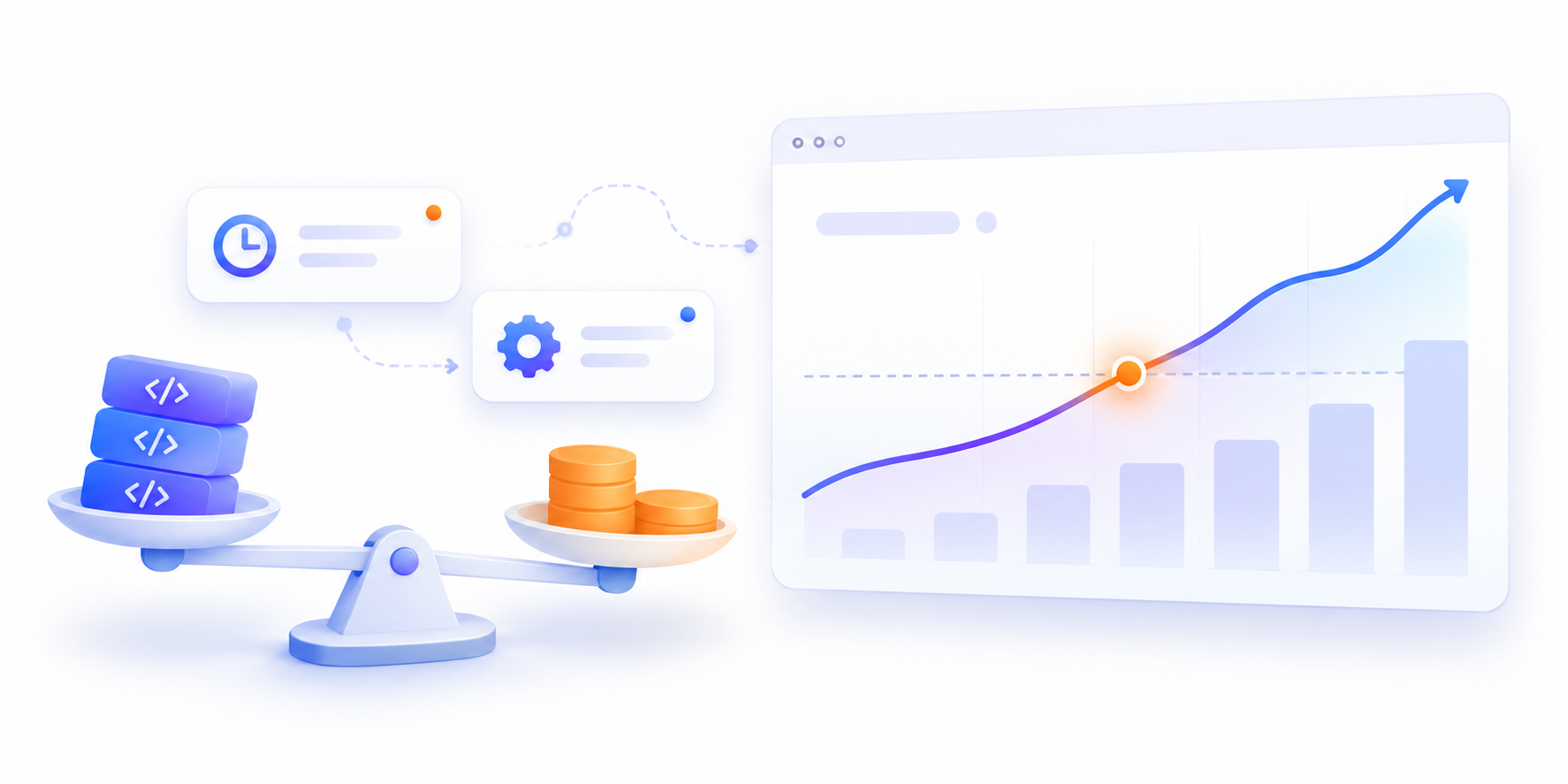
Simple MVP (1-2 main flows, no complex integrations): between 1,500€ and 5,000€
Mid-range MVP (multiple flows, admin panel, 1-2 integrations): between 5,000€ and 25,000€
Complex platform or specific scalability requirements: from 25,000€
Be cautious about quotes significantly below these ranges without a clear justification. In software development, cheap almost always turns out to be the most expensive option in the medium term. Also factor in recurring costs: hosting, domains, maintenance, and updates.
Freelancer: more affordable, but with higher risk around availability and continuity. Best for small projects.
Development agency or studio: more structure, a defined process, and a complete team. Higher cost but greater delivery certainty.
Internal team: the best long-term option if the product is the core of your business, but requires sustained investment.
For an MVP, the most balanced option is working with a specialist development company that can guide you from definition through to launch.
The MVP is not the final product. It is the starting point for learning with real users. Metrics you should define before launch:
How many users complete the main flow?
Where do they drop off?
How many return after 7 and 30 days?
Are they willing to pay (or already paying)?
With that data, your product decisions will be grounded in evidence. The cycle of a successful digital product is always the same: build, measure, learn, and repeat.
Tell us about your idea and we will help you map the most direct path to your first digital product.
It depends on scope and technology. A simple MVP can start from 1,500€, a mid-range one between 5,000€ and 25,000€, and more complex platforms from 25,000€. The most important thing is to define the scope clearly before requesting a quote.
No. You need clarity on the problem you are solving and the user you are targeting. The technical team handles technology decisions and development.
A well-defined MVP with an experienced team can be ready in 6 to 10 weeks. More complex projects or those with unclear scope can take several months.
The MVP is the minimum version that validates the core business hypothesis with real users. The complete app includes all the features added based on what you learn from the MVP.
It depends on the case. No-code allows fast and lower-cost launches, but has customisation and scalability limits. Custom development is more flexible and scalable, but requires greater initial investment.
Yes. User interviews, landing pages, Figma prototypes, and manual operation are all ways to validate real demand before investing in technology.
Our clients' satisfaction is our best introduction.
"Tengo un negocio de Paquetería, en el que vienen muchas personas diariamente, tanto para recoger como para dejar paquetes. Llevábamos años gestionando muchos de nuestros procesos de paquetería de forma manual, y gracias a Blimbur Technologies hemos dado un salto enorme. Nos desarrollaron una app móvil y una web totalmente adaptadas a nuestro flujo de trabajo, con las que ahora tenemos todo automatizado, trazable y mucho más rápido. Ahora, el cliente sabe si tenemos el paquete y al estar todo mucho más organizado, es mucho más rápido y ágil, lo que hace que los clientes vengan y se vayan con otra cara y sin esperas. El trato ha sido impecable y el resultado, todavía mejor. Un equipo serio, técnico y que se implica de verdad."