Contents
Almost no software starts out complex. It starts with one simple connection: the CRM talking to email, a payment gateway, a spreadsheet that syncs on its own. Each one solves a specific problem and looks harmless.
The problem is never the first integration. Or the second. It is the eighth, the twelfth, the one added a year ago that nobody remembers anymore. Once you reach that point, a small change can break something in an unexpected place, and no one is quite sure why.
This article is here to help you spot that point before you reach it. Because the question of how many integrations your software can handle has a far less numerical answer than it seems.
When we talk about integrations, we do not just mean the big, visible connections. Everything that links your software to something you do not control counts:
Third-party APIs (payments, messaging, billing, maps).
Syncs with other internal tools (CRM, ERP, support).
Webhooks that trigger automatic actions.
Scheduled imports and exports.
External authentication services.
Each of these connections is a point where your system depends on something outside it. And anything you depend on but do not control is, by definition, a risk you have to manage.
On paper, adding an integration is "connecting A to B." In practice, every connection brings a list of things to maintain:
The external service changes its API and your integration stops working.
They go down for a day and your system has to know what to do in the meantime.
Access keys expire or rotate and need updating.
Usage limits throttle you exactly when traffic is highest.
Data arrives in a different format from the one you expected.
A single integration is manageable. The problem is that these risks do not add up, they multiply. When many connections talk to each other, a failure in one can drag down the rest, and tracing the source becomes a job in itself.
You do not need to count integrations to know something is off. These signs usually show up before the number does:
Nobody on the team can list every integration the system has.
Every change, however small, is scary because no one knows what it might break.
There are silent failures: things stop syncing and you find out days later.
Onboarding a new developer takes weeks just to understand how everything is wired together.
Maintenance eats up more and more time and leaves less for building new things.
If two or three of these sound familiar, the exact number of integrations is irrelevant. The system is already crying out for a reorganisation.
Here is the important part: there is no magic number. We have seen software with three integrations that was a mess, and platforms with thirty that ran like clockwork.
The difference is not how many connections you have, but how they are wired. When every integration connects directly to everything else, the tangle grows exponentially: adding a new one forces you to touch several pieces at once.
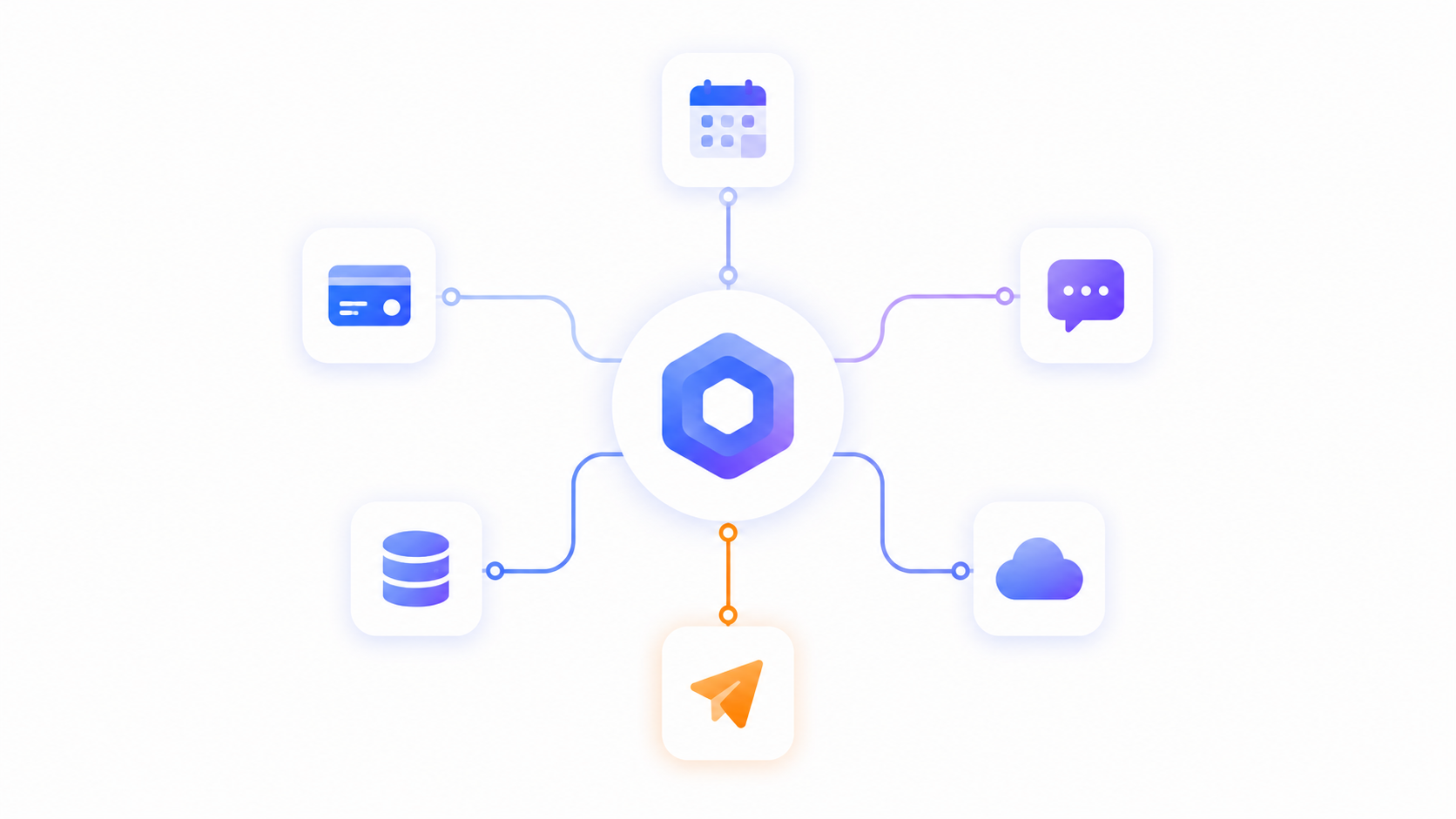
When, instead, there is an intermediate layer that centralises the connections, adding or removing an integration stops being a risky operation. That is the real ceiling: not the number of integrations, but whether or not you have a structure that keeps them in order.
You do not need to rebuild everything to regain control. A few principles make almost all the difference:
Centralise the connections: an integration layer or middleware stops each piece from depending directly on all the others.
Monitor what comes in and what goes out: if an integration fails, you should find out before your customer does.
Document every connection: what it does, what it depends on, and what happens if it goes down, instead of living only in one person’s head.
Handle errors gracefully: retries, alerts, and a plan for when the external service does not respond.
Review regularly: integrations nobody uses anymore still add complexity and risk.
If maintaining your integrations is eating the time you should be spending on improving your product, that is the moment to stop and look at the architecture calmly.
It does not always mean rebuilding from scratch. Often it is enough to introduce an intermediate layer, tidy up what already exists, and remove what is no longer needed. The investment pays off quickly: every future change becomes faster, cheaper, and far less risky.
Your software does not become unmanageable from having many integrations, but from lacking a structure to manage them. The number is just a symptom; the architecture is the cause.
If each new connection costs more than the last and the system has grown fragile, you do not have too many integrations. It is simply time to put them in order.
Tell us how your software is wired and we will work out together where to start tidying it up.
There is no fixed number. A system with three badly wired integrations can be more fragile than one with thirty well-organised ones. The real limit is whether you have a layer that centralises them and a way to monitor them, not the count itself.
It is an intermediate piece that centralises the connections to external services, instead of each part of your software depending directly on all the others. It lets you add, change, or remove integrations without touching the whole system and greatly reduces the risk of every change.
Some clear signs: nobody can list every integration, every change feels risky, failures are discovered days late, and maintenance eats into development time. If several of these sound familiar, the system already needs reorganising.
For one or two occasional integrations, a direct connection may be enough. Beyond that, middleware or an integration layer almost always pays off: it stops complexity from growing exponentially every time you add something new.
Sometimes, but the biggest benefit is usually maintainability rather than speed. Removing integrations nobody uses cuts points of failure, risk, and maintenance time, even if you do not notice an immediate change in performance.
When maintaining the connections consumes the time you should be spending on improving the product. It does not always mean starting from scratch: often it is enough to introduce an intermediate layer and tidy up what already exists.
Our clients' satisfaction is our best introduction.
"Tengo un negocio de Paquetería, en el que vienen muchas personas diariamente, tanto para recoger como para dejar paquetes. Llevábamos años gestionando muchos de nuestros procesos de paquetería de forma manual, y gracias a Blimbur Technologies hemos dado un salto enorme. Nos desarrollaron una app móvil y una web totalmente adaptadas a nuestro flujo de trabajo, con las que ahora tenemos todo automatizado, trazable y mucho más rápido. Ahora, el cliente sabe si tenemos el paquete y al estar todo mucho más organizado, es mucho más rápido y ágil, lo que hace que los clientes vengan y se vayan con otra cara y sin esperas. El trato ha sido impecable y el resultado, todavía mejor. Un equipo serio, técnico y que se implica de verdad."