Contents
A salesperson spends a big chunk of the day on things that are not selling: copying data from an email into the CRM, writing the same follow-up message again, digging through threads to find where a conversation left off, building a quote by hand, or putting together the report for Monday’s meeting.
None of those tasks closes a deal, yet all of them eat time, energy and focus. When they pile up, you have an expensive team doing administrative work that does not need their talent.
The question is not whether your team works hard. It is how much of that work a system could handle while they talk to customers.
Not everything can be automated, but a group of repetitive, predictable tasks takes up most of the wasted time. These are the most common:
The pattern is clear: if a task always follows the same steps and relies on information that already lives in a system, it can almost always be automated.
Picture a team that gets leads from a web form, a couple of campaigns and the odd direct email. Today, someone copies each lead into the CRM by hand, decides who handles it, and writes a first message.
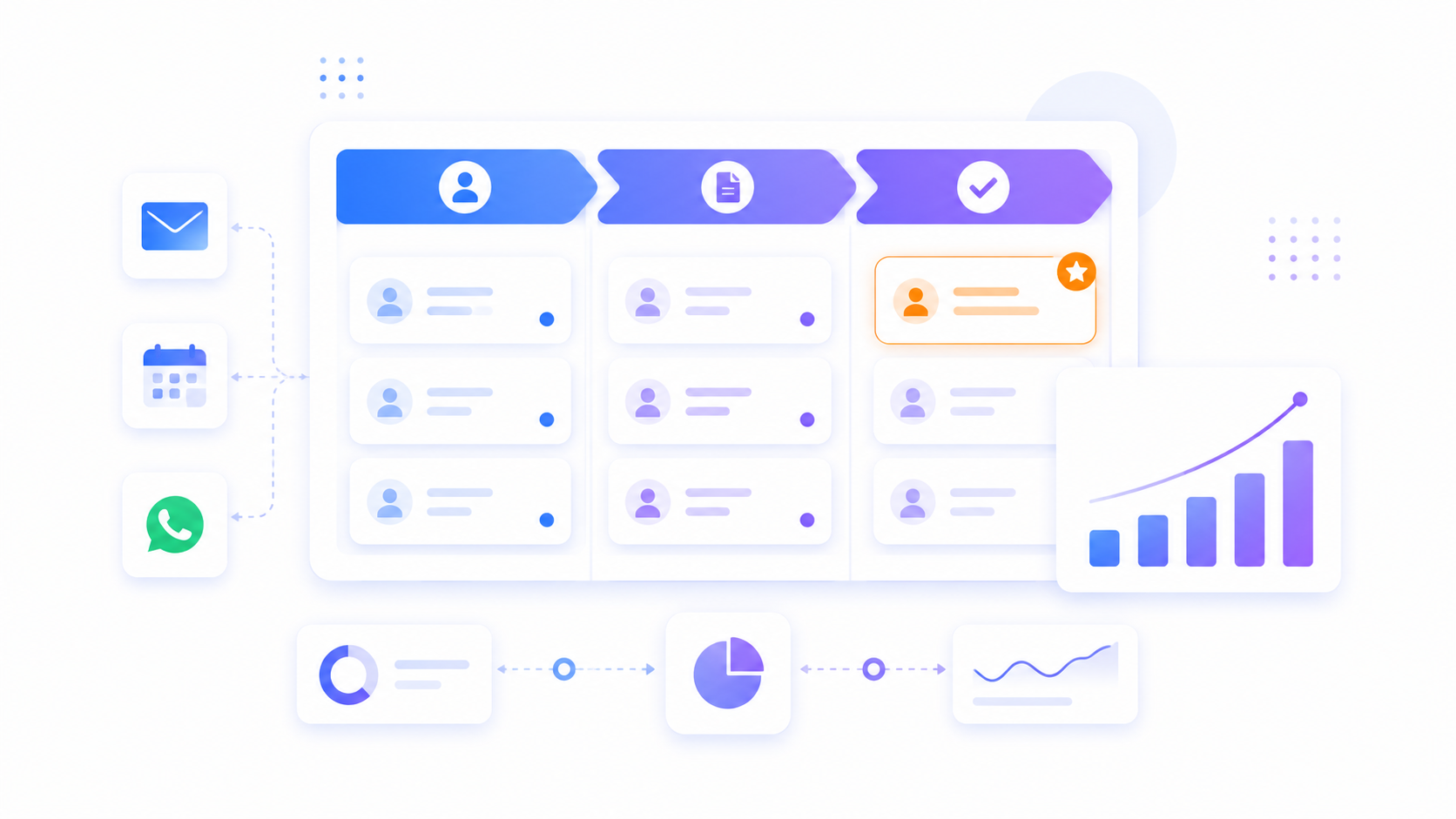
With an automated flow, the lead lands in the CRM on its own with its source tagged, gets assigned to a rep based on a set of rules, and triggers a first personalised email. The rep gets the notification and, instead of doing admin, starts the conversation right away.
This is not science fiction and it does not need a huge project. It is connecting tools the company already uses so they talk to each other.
Automating does not mean removing people from the equation. There are parts of the sales process where human judgement is exactly what adds value:
Automation works best as support: it handles the repetitive part so the team can spend its time on what genuinely needs a person.
There are fairly clear signs that you are losing time and money on automatable tasks:
If you recognise three or more of these, there is probably plenty of room to improve without hiring anyone new.
You do not need to redesign the whole sales process at once. The sensible approach is to start where it hurts most:
This step-by-step approach delivers visible results quickly and avoids the risk of a big project that takes months to pay off.
If your sales team spends hours on tasks a system could do, it is not an effort problem, it is a tools problem. Every hour spent on admin is an hour not spent with customers.
The good news is that automating the repetitive part rarely takes a big investment. It usually means connecting what you already have and designing the flows sensibly.
Tell us which tasks are eating your sales team’s time and we’ll show you what can be automated in your case.CRM data entry, follow-ups and reminders, lead qualification and routing, quote and proposal generation, reporting, and scheduling. In general, any repetitive task that always follows the same steps and relies on data that already exists.
No. Automation handles the repetitive work so the team can spend its time selling, negotiating and building relationships, which is where a person adds real value.
It depends on the scope. A simple automation starts from 500 – 1.000€ and a medium-complexity one usually sits between 2.000€ and 5.000€. The sensible move is to start with one specific flow and measure the savings before scaling up.
Usually not. Most automations are about connecting the tools you already use so they share information, without migrating to a new system.
If you start with a single, well-chosen task, the first results can show up within a few weeks. The step-by-step approach avoids long projects that take time to pay off.
With the task that repeats most and consumes the most time. You automate that first flow, measure it, and once it works, move on to the next one.
Our clients' satisfaction is our best introduction.
"Tengo un negocio de Paquetería, en el que vienen muchas personas diariamente, tanto para recoger como para dejar paquetes. Llevábamos años gestionando muchos de nuestros procesos de paquetería de forma manual, y gracias a Blimbur Technologies hemos dado un salto enorme. Nos desarrollaron una app móvil y una web totalmente adaptadas a nuestro flujo de trabajo, con las que ahora tenemos todo automatizado, trazable y mucho más rápido. Ahora, el cliente sabe si tenemos el paquete y al estar todo mucho más organizado, es mucho más rápido y ágil, lo que hace que los clientes vengan y se vayan con otra cara y sin esperas. El trato ha sido impecable y el resultado, todavía mejor. Un equipo serio, técnico y que se implica de verdad."