Contents
"How long will this take?" is the first question any business asks before signing off on a development project. It's a fair question: budgets depend on it, launches get promised to investors, and internal teams are waiting to start using the new tool.
The problem is that the honest answer is almost never a fixed number. It depends on very specific decisions that, in most cases, have not been made yet when the question is asked.
Not every web platform takes the same time to build, even if they look similar on paper. The factors that actually determine the timeline are:
Multiple user roles with different permissions and views (customer, admin, operator, supplier...).
Integrations with external systems: ERPs, payment gateways, CRMs, third-party APIs.
Custom business logic: pricing rules, approval workflows, sector-specific calculations.
Management dashboards and reporting with real-time data.
Scalability requirements: many concurrent users, high data volume.
Internal automations connecting several tools to one another.
A platform with two or three of these elements is already beyond a simple build. And each additional element does not add time linearly - it multiplies it, because it introduces dependencies with the rest of the system.
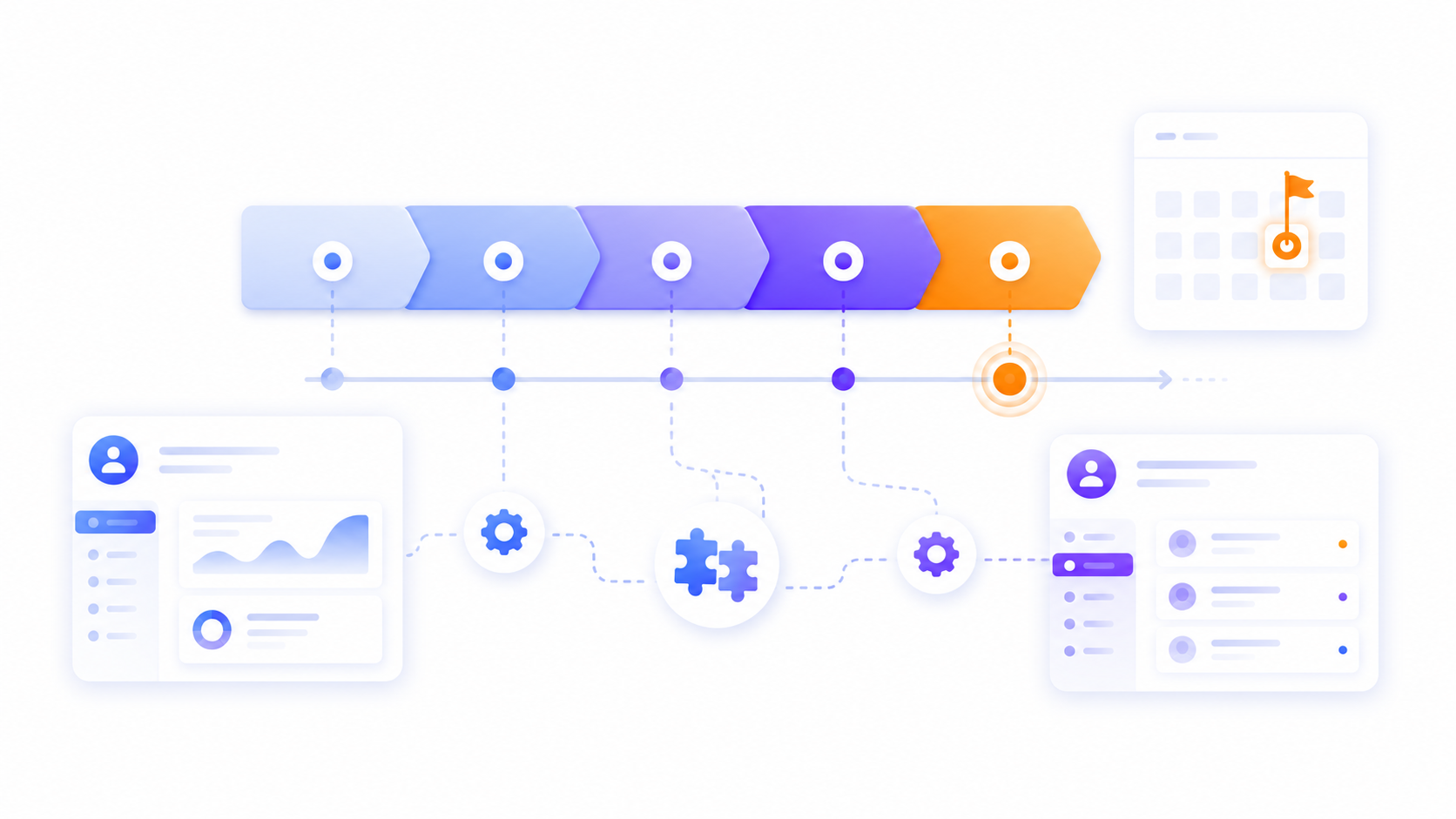
When people talk about "development time," most think only of the coding phase. But a web platform project has, at minimum, five phases:
Definition and functional analysis: what is being built, for whom, and under which business rules. Between 2 and 4 weeks depending on how much clarity exists at the start.
UX/UI design: wireframes, user flows, and visual design for each role. Between 2 and 4 weeks, usually running in parallel with the start of the technical architecture.
Architecture and backend development: database, business logic, internal APIs. This is the longest phase and absorbs most of the integration work. Between 6 and 14 weeks depending on scope.
Frontend development: interfaces for each role, dashboards, and user flows. Usually runs in parallel with the backend, between 6 and 12 weeks.
Testing, integration, and stabilization: QA, bug fixing, performance tuning, and production deployment. Between 3 and 6 weeks.
Adding these phases together, a well-planned web platform typically lands between 2 and 9 months from start to finish, depending on how many of the factors above are present. Below that range, some part of the scope is being simplified. Above it, there is usually a definition or project management problem.
Almost no major delay comes from "the code taking longer than expected." It comes from decisions and circumstances no one anticipated at the start:
Integrations with legacy or poorly documented systems: connecting to an old ERP or an API with no clear documentation can add weeks that nobody can accurately predict in advance.
Scope changes mid-project: adding a user role or a new feature once development has started does not cost the same as having included it from day one.
Delayed decisions on the client side: approvals that get delayed, content that does not arrive, feedback that takes weeks to come back.
Regulatory compliance requirements: data protection, electronic invoicing, or sector-specific regulations that require additional validation.
Third-party dependencies: payment gateways, infrastructure providers, or external APIs that do not respond as quickly as expected.
None of these factors make a project unfeasible. But they do explain why two platforms that look similar in the initial proposal can end up taking very different amounts of time in production.
There is real room to reduce timelines, but it does not come from working faster on a poorly defined scope. It comes from making better decisions before starting:
Define the scope with precision before writing a single line of code, including what is explicitly left out.
Prioritize a first launch with the core features and leave secondary ones for later phases.
Choose a modular architecture that allows adding features without rebuilding what already exists.
Validate critical integrations at the start of the project, not at the end, when there is no room left to react.
Keep a single decision-maker on the client side to avoid bottlenecks caused by approvals.
Building in phases - launching the core version and adding features afterward - almost always reduces the time to first real value, even if the full project still has a longer overall timeline.
If you are given a delivery date for your web platform, there are signs worth checking before you sign:
The timeline is given before the roles, integrations, and business logic have been defined in detail.
There is no mention of a discovery or functional analysis phase.
The schedule leaves no room for testing or adjustments after the first round of feedback.
A very short timeline is promised for a scope that includes several of the factors mentioned above.
There are no interim milestones: all the work is delivered at once at the end.
There is no single number that answers "how long does a web platform take." There is a reasonable range - between 2 and 9 months for most cases - that depends directly on how many roles, integrations, and business rules the project involves.
The way to shorten that timeline is not to promise less time than the project actually needs. It is to define the scope better, prioritize what matters most, and build in phases with clear milestones.
If you need a realistic timeline for your project, with phases and deadlines adjusted to your specific case, we can help you define it before you start hiring.
Tell us about your project and we'll give you a real timeline, no empty promises.
For most cases, between 2 and 9 months from start to finish, depending on the number of user roles, integrations, and business rules involved.
Integrations with legacy or poorly documented systems, mid-project scope changes, and delayed client-side decisions or approvals are the most common causes.
Yes, by defining the scope precisely from the start, prioritizing core features for a first launch, and validating critical integrations early in the project.
Launching the core version first and adding features afterward almost always reduces the time to real value, even if the full project keeps a longer overall timeline.
Every scope change mid-project adds time non-linearly, because it affects decisions already made in the architecture and the rest of the features.
Our clients' satisfaction is our best introduction.
"Tengo un negocio de Paquetería, en el que vienen muchas personas diariamente, tanto para recoger como para dejar paquetes. Llevábamos años gestionando muchos de nuestros procesos de paquetería de forma manual, y gracias a Blimbur Technologies hemos dado un salto enorme. Nos desarrollaron una app móvil y una web totalmente adaptadas a nuestro flujo de trabajo, con las que ahora tenemos todo automatizado, trazable y mucho más rápido. Ahora, el cliente sabe si tenemos el paquete y al estar todo mucho más organizado, es mucho más rápido y ágil, lo que hace que los clientes vengan y se vayan con otra cara y sin esperas. El trato ha sido impecable y el resultado, todavía mejor. Un equipo serio, técnico y que se implica de verdad."