Contents
Almost every company that has been around for a few years has a system like this: it still works, it processes orders, invoices, manages customers. But nobody on the team wants to touch it. Every small change takes weeks. Every update breaks something else. And when a certain part of the code needs to change, the person who built it no longer works there.
That is legacy software. It is not a question of age, it is a question of cost: how much it costs to change it, maintain it, and grow it at the pace the business needs. That cost, left unaddressed, becomes the main obstacle to scaling.
The problem is usually discovered late: a key client asks for an integration the system cannot support, or a successful marketing campaign overloads a server that was never built for that volume. In both cases, the business loses an opportunity because of a technical limitation that could have been anticipated.
This article explains what legacy software actually is, when modernizing it pays off, when it is better to wait, and how to approach modernization without stopping operations or putting business data at risk.
The term is almost always misused. Legacy software does not mean "old system." It means a system that can no longer be changed with the speed and safety the business needs, regardless of its age.
A system built two years ago can be legacy if it was rushed, built without thinking about growth, and now every new feature requires touching half the codebase. A ten-year-old system, if properly maintained, updated in parts, and documented, can still be perfectly viable.
The traits that define legacy software tend to combine, rather than appear alone:
Technologies or languages that no longer receive support or security updates.
Monolithic architecture where any small change affects the entire system.
Dependencies on discontinued libraries or ones with known vulnerabilities.
Missing or outdated documentation.
System knowledge concentrated in one or two people, inside or outside the company.
None of these signs alone is a reason for alarm. Several of them together usually are, and that is typically the moment to consider a technical audit.
Before talking about budgets or technology, it is worth confirming the problem is real. These are the signs that modernization is no longer optional:
Changes that should take days end up taking weeks, and nobody can fully explain why.
The technical team avoids touching certain modules for fear of breaking production.
It is getting harder, and more expensive, to find developers who know the system's technology.
The system slows down or fails as user volume or order volume increases.
It cannot be integrated with current tools: payment gateways, CRMs, AI-driven automation.
Server, licensing, or maintenance costs keep rising without the system doing anything more than before.
Fixing one bug almost always creates one or two new ones somewhere else.
The business has changed in size or model, but the software is still built for how it operated years ago.
If you recognize three or more of these signs, it is worth running at least a technical audit before investing in more patches.
The decision not to modernize is rarely made explicitly. Changes simply keep getting postponed because other priorities take over. The problem is that the cost does not disappear, it accumulates.
Development hours that should go toward new product, spent instead keeping the current system afloat.
Lost business opportunities because the system cannot integrate with what a potential client needs.
Security risk from unsupported dependencies, especially relevant when handling customer or payment data.
Developer turnover, as engineers avoid specializing in outdated technology.
A launch speed far slower than competitors running on more modern, flexible systems.
In most cases, this cost never shows up on any spreadsheet. But it is there, and over time it usually ends up far exceeding what modernizing earlier would have cost.
In evolutionary maintenance projects, it is common to find that a large share of a team's development hours go toward keeping an old system alive, instead of building what actually moves the business forward. That imbalance, sustained for years, is what turns a manageable technical problem into a structural limitation.
There is also a less visible but equally real cost: team burnout. Working daily on a fragile system, afraid that any deployment might break something, eventually wears down morale and retention, whether the team is in-house or an external partner.
This is the most common misconception: assuming that modernizing means throwing away the current system and starting over. In most cases, that is the most expensive and riskiest option, not the most sensible one.
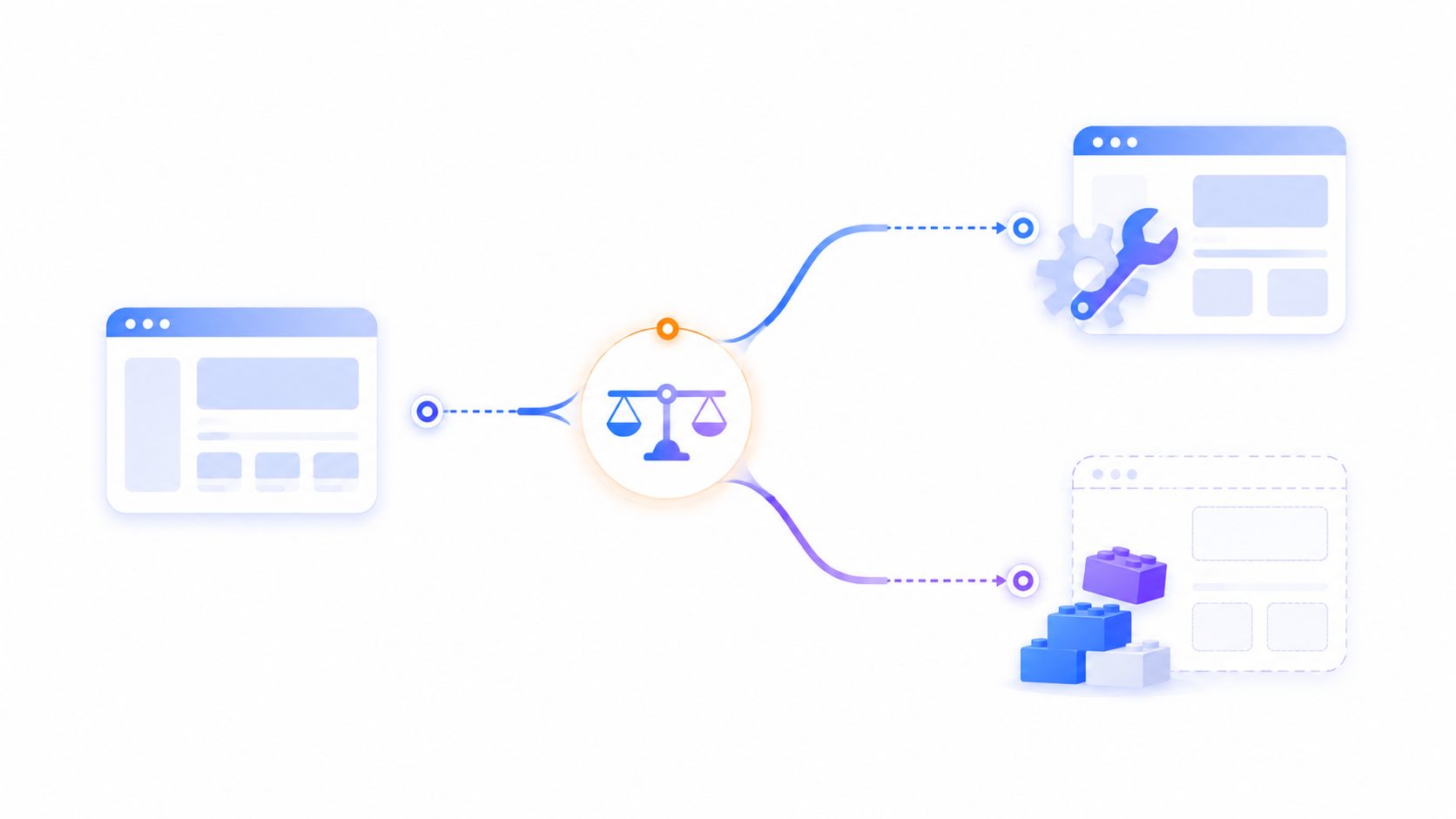
There are at least three strategies, and the right one depends on the state of the system and how much downtime the business can afford:
Incremental refactoring: improving the architecture and code internally without changing what the user sees, step by step, with frequent deployments. This is the lowest-risk option when the system is still viable but carries technical debt.
Progressive replacement (strangler fig pattern): the new system is built around the old one, migrating module by module while both coexist. End users do not notice the change until each part has been validated. This is the safest strategy for critical systems that already have real users.
Full rewrite: only makes sense when the system is small, the architecture cannot support the current business model, or maintenance costs already clearly exceed the cost of rebuilding.
Progressive replacement works especially well when the current system already has active users and data that cannot be lost. Instead of migrating everything at once, the highest-impact or highest-risk module is identified, its modern version is built, validated with real data in parallel, and only then is the old version of that module retired. The rest of the system keeps running exactly as before in the meantime.
In projects where we have migrated existing applications toward more modern architectures, progressive replacement has, in most cases, been the option that allowed modernization without interrupting the service or putting existing data at risk.
Modernizing is not always the right call right now. It is worth it when:
Business growth is technically limited by the current system, not by the market.
There is a clear need to integrate with payment, AI, or third-party tools the system cannot support.
There are security or regulatory compliance requirements the current system cannot guarantee.
Annual maintenance cost is already approaching the cost of a partial modernization.
It is increasingly difficult or expensive to find technical talent willing to work with that technology.
And it is probably not the right time when:
The system is stable, changes rarely, and is not blocking any business decision.
The company is about to pivot or change its model, and the current system might become obsolete anyway.
The available budget would better solve a more urgent problem in the customer-facing part of the product.
A common mistake is making the decision based purely on technology, "this is outdated", without measuring the actual business impact. The right question is not whether the system is old, but whether its current state is costing more, in time, money, or lost opportunities, than modernizing it would.
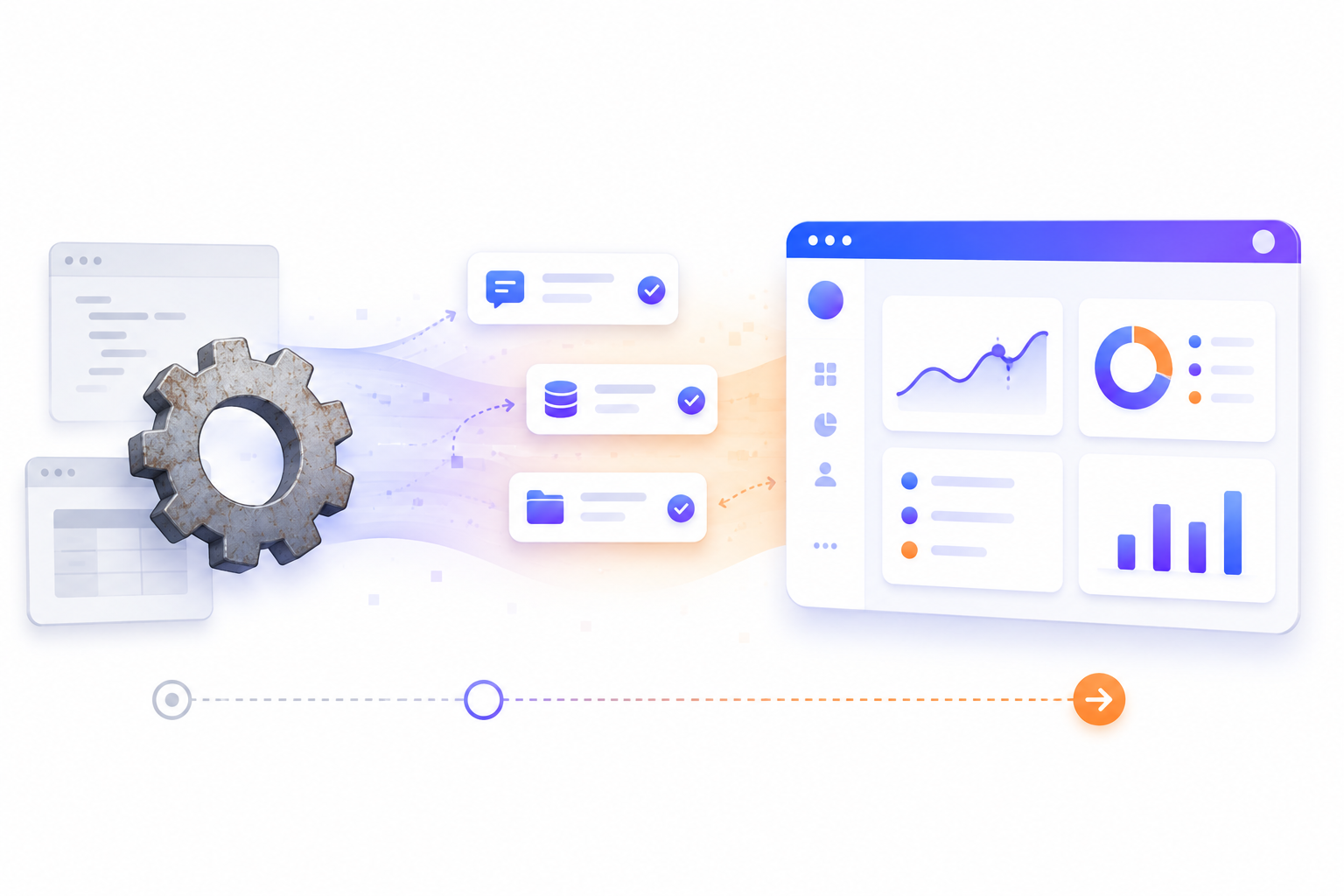
The timeline depends on the size of the system and how many modules are truly critical, but a well-structured process usually follows a similar sequence:
Technical audit (1-2 weeks): full system mapping, risk identification, and module prioritization.
Phased modernization plan: defining what gets migrated first, with which strategy and which validation criteria.
Module-by-module execution, typically 4 to 8 weeks per module depending on complexity: development, testing, and deployment of each phase independently.
Stabilization and monitoring: a coexistence period between old and new systems before the legacy code is finally retired.
A full modernization project for a medium-sized system usually spans several months, but the business keeps operating normally throughout, because the change happens in phases rather than all at once.
Data migration deserves a separate mention: it is usually the most underestimated part. Cleaning, transforming, and validating data that has accumulated in the old system for years almost always takes longer than writing the new code, and it should be planned from day one, not left until the end.
The biggest fear around modernization is not technical, it is operational: stopping the system, losing data, or ending up with a half-finished migration that leaves everything worse than before. A well-structured process removes most of that risk.
Technical audit first: mapping which parts of the system are critical, which generate the most incidents, and which can wait. Without this, any modernization plan is just a guess.
Prioritization by impact and risk: starting with the modules causing the most problems or blocking the most business opportunities, not the ones that are technically easiest to touch.
Phased migration, not all at once: each module is migrated, validated in production, and stabilized before moving to the next.
Temporary coexistence of both systems: the old system keeps running in parallel until the new part has been tested with real data and real users.
Automated testing and a rollback plan: every phase must be reversible if something does not work as expected, without relying on manual intervention under pressure.
Ongoing communication with the team that uses the system: the people working with the system daily catch risks and edge cases that no technical document will capture.
This approach makes modernization slower than a full rewrite, but far safer. And for systems that already generate revenue, safety is worth more than speed.
Trying to modernize the entire system at once, instead of in prioritized phases.
Not having a clear rollback plan for each stage of the migration.
Underestimating the time and complexity of migrating data, not just code.
Modernizing without first understanding why the system was built that way originally.
Not involving the team that uses the system daily in prioritization decisions.
Choosing the newest technology on the market instead of the one best suited to the team and the business.
Before proposing anything, we start with a technical audit: which parts of the system are sustainable, which are a real risk, and what impact each one has on the business. From there we build a phased modernization plan, with a clear budget and timeline for each phase.
Targeted projects, such as specific improvements or migrating individual modules, usually range from 1,000€ to 5,000€. Medium-complexity projects, involving integrations and multiple user roles, tend to run 5,000€ to 15,000€. A full architecture redesign on large, complex platforms starts at 15,000€. The goal is always the same: keep the business running throughout the entire process, and leave the system better off after every phase, not in a more fragile intermediate state.
Modernizing legacy software is not a technical decision, it is a business decision. The question is not whether the system is old, but whether its current state is limiting growth, security, or how fast the company can move.
Done right, with a prior audit, clear phases, and coexistence between systems, it is a process that can be planned and controlled, without surprises or operational downtime.
If you suspect your current system is costing you more than it appears to, we can give you an honest assessment of what is worth modernizing and what is not.
Tell us how your current system works and we will tell you what is worth modernizing.
It is not about age, it is about the cost of change. If every modification takes far longer than it should, if the team avoids touching certain parts for fear of breaking something, or if it depends on unsupported technologies, it is legacy, regardless of how old it is.
No, and in most cases that is not the best option. Strategies like incremental refactoring or progressive module-by-module replacement are usually faster, cheaper, and far less risky than a full rewrite.
Yes, that is the main goal of a well-structured process. By migrating in phases and keeping the old system running in parallel while each new module is validated, the business keeps operating normally throughout.
It depends on the scope and size of the system. Targeted modernization projects, such as specific improvements or migrating individual modules, usually range from 1,000€ to 5,000€. Medium-complexity projects, involving integrations and multiple user roles, tend to run 5,000€ to 15,000€. A full architecture redesign on large, complex platforms starts at 15,000€.
An initial technical audit usually takes 1 to 2 weeks. From there, each module is migrated in phases of 4 to 8 weeks depending on complexity, and a full project for a medium-sized system usually spans several months.
Our clients' satisfaction is our best introduction.
"Tengo un negocio de Paquetería, en el que vienen muchas personas diariamente, tanto para recoger como para dejar paquetes. Llevábamos años gestionando muchos de nuestros procesos de paquetería de forma manual, y gracias a Blimbur Technologies hemos dado un salto enorme. Nos desarrollaron una app móvil y una web totalmente adaptadas a nuestro flujo de trabajo, con las que ahora tenemos todo automatizado, trazable y mucho más rápido. Ahora, el cliente sabe si tenemos el paquete y al estar todo mucho más organizado, es mucho más rápido y ágil, lo que hace que los clientes vengan y se vayan con otra cara y sin esperas. El trato ha sido impecable y el resultado, todavía mejor. Un equipo serio, técnico y que se implica de verdad."