Contents
Hardly any team asks this question while things are going well. It comes up when every change takes too long, when one fix breaks something else, or when the developer who knew the codebase has left and nobody dares touch certain parts.
At that point two paths appear: improve what exists or rebuild it from scratch. And it is no small decision. Choosing wrong can mean months of work and a budget that evaporates without solving the underlying problem.
This article does not argue for either option. Its goal is to give you the criteria to know which one fits your case, before you commit time and money.
It helps to separate two concepts that often get mixed up.
Improving means working on the existing base: fixing bugs, optimising what runs slowly, adding features, or modernising specific parts without tearing down what already works.
Rewriting means building again, fully or partly, starting from zero or close to it. The idea and the business logic are kept, but the code is redone.
Improving is usually cheaper and faster in the short term. A rewrite is a bigger investment that only makes sense when keeping the current system costs more than rebuilding it.
In most cases, an app that gives you trouble is not broken: it is neglected. These signs point to improvement being enough:
The problems are isolated and localised, not affecting the whole system.
The code is understandable and a new developer can find their way in a few days.
The underlying technology still has support and an active community.
The failures come from a lack of maintenance, not from architectural decisions.
You can add features without every change turning into a battle.
Performance improves noticeably when you optimise specific points.
If this sounds like your situation, rewriting would be throwing money away. What you need is an evolution plan, not a fresh start.
Other times the problem is not on the surface but in the foundations. These signs suggest that continuing to patch will cost more than rebuilding:
Every change breaks something elsewhere: a symptom of code so tangled that nobody controls its side effects anymore.
The technology is obsolete or unsupported: an abandoned framework, versions that no longer receive security patches, dead dependencies.
Nobody understands the code: if the knowledge left with one person and there is no documentation, every intervention is a gamble.
It cannot scale: the app handles a hundred users but falls over at a thousand, and fixing it means redoing the foundation.
Adding the simplest thing takes weeks: when the cost of evolving exceeds the cost of rebuilding, the maths changes.
There are structural security risks: vulnerabilities that cannot be closed without redesigning how the application works.
When several of these signs pile up, maintaining the app stops being a saving and becomes a recurring, endless expense.
The most expensive option is usually neither improving nor rewriting. It is staying in no man's land: continuing to patch an app that has nothing left to give, while the team spends more and more hours just keeping it alive.
That cost never shows up on an invoice, but you pay it anyway: in development speed dropping month after month, in features that never ship, in customers leaving over bugs, and in developers who avoid touching the project.
Deciding, one way or the other, almost always works out cheaper than not deciding.
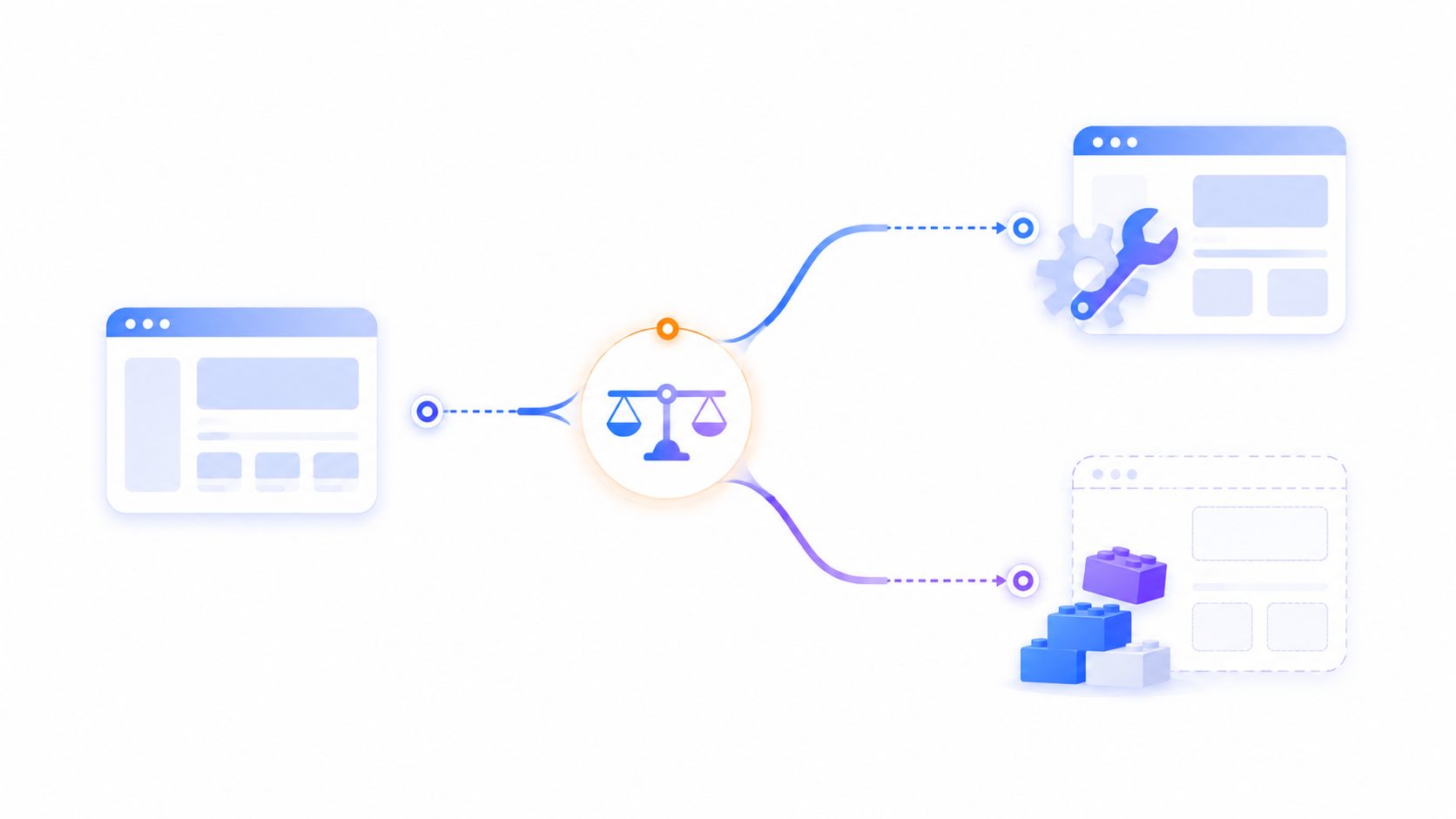
A rewrite does not have to be a leap into the void where the old app is switched off and the new one switched on the same day. There is a middle path that drastically reduces the risk.
It means rewriting the application module by module, replacing pieces of the old system with new ones gradually, while everything keeps running. Users notice nothing; under the hood, the app renews itself piece by piece.
It is slower than a full rewrite, but it avoids the risk of paralysing the business for months and lets you spread the investment over time. For many companies, it is the most sensible option.
Before deciding, it is worth answering a few questions honestly:
Are the problems isolated or structural?
How much does maintaining the current app cost each month, counting team hours?
Does the current technology have a future, or is it in decline?
Can the business take the risk of a full rewrite, or does it need continuity?
Is there documentation and someone who understands the system, or are you starting from zero anyway?
With those answers, the decision stops being a hunch and becomes a calculation. And often the conclusion is neither rewriting everything nor leaving it as is, but something well-planned in between.
Not every app with problems needs rewriting, and not every old app can be saved with improvements. The key is telling whether the problems are on the surface or in the foundations.
If they are isolated, improve. If they are structural, consider rewriting, ideally in stages. And if you have spent months patching without progress, the only certainty is that not deciding is the most expensive option.
The hard part is rarely executing the change. It is having an honest diagnosis of where your app stands and what it truly needs.
Almost always, in the short term. An improvement builds on what already exists, so it costs less time and money. A rewrite only pays off when keeping the current app costs more each month than rebuilding it. The right question is not which is cheaper today, but which is cheaper over the next two years.
It depends on scope. An MVP-scale rewrite can take between 8 and 12 weeks; a complex platform, several months. Done in stages, replacing modules gradually, the timeline lengthens but the business never stops. Any serious estimate starts with reviewing the current code first.
Yes, if it is done gradually. A module-by-module rewrite lets you replace pieces of the system while the rest stays in production. A full all-at-once rewrite does involve a transition period, which is why the staged path is safer for many businesses.
A technical review clears it up in a few days. If the failures come from overloaded or badly configured servers, it is infrastructure and can be solved without touching the code. If they come from tangled code with no tests or documentation, the problem is structural. Confusing the two leads to investing on the wrong side.
Not automatically. A rewrite without solid design behind it can reproduce the same mistakes with new technology. What prevents problems from returning is not redoing the code, but understanding why the previous one failed and building with maintenance, tests, and documentation from the start.
Our clients' satisfaction is our best introduction.
"Tengo un negocio de Paquetería, en el que vienen muchas personas diariamente, tanto para recoger como para dejar paquetes. Llevábamos años gestionando muchos de nuestros procesos de paquetería de forma manual, y gracias a Blimbur Technologies hemos dado un salto enorme. Nos desarrollaron una app móvil y una web totalmente adaptadas a nuestro flujo de trabajo, con las que ahora tenemos todo automatizado, trazable y mucho más rápido. Ahora, el cliente sabe si tenemos el paquete y al estar todo mucho más organizado, es mucho más rápido y ágil, lo que hace que los clientes vengan y se vayan con otra cara y sin esperas. El trato ha sido impecable y el resultado, todavía mejor. Un equipo serio, técnico y que se implica de verdad."