Contents
When a startup or company decides to build a digital product, one of the first questions that comes up is whether they need a native app or whether a web app is enough. This decision often gets made too quickly — sometimes because it is trendy, sometimes because a competitor did it that way, and almost never based on a real analysis of what the business actually needs.
The problem is that this decision shapes the budget, the timeline, and the product's ability to evolve later on. Getting it wrong does not just cost money — it can force you to rebuild the product from scratch months down the line.
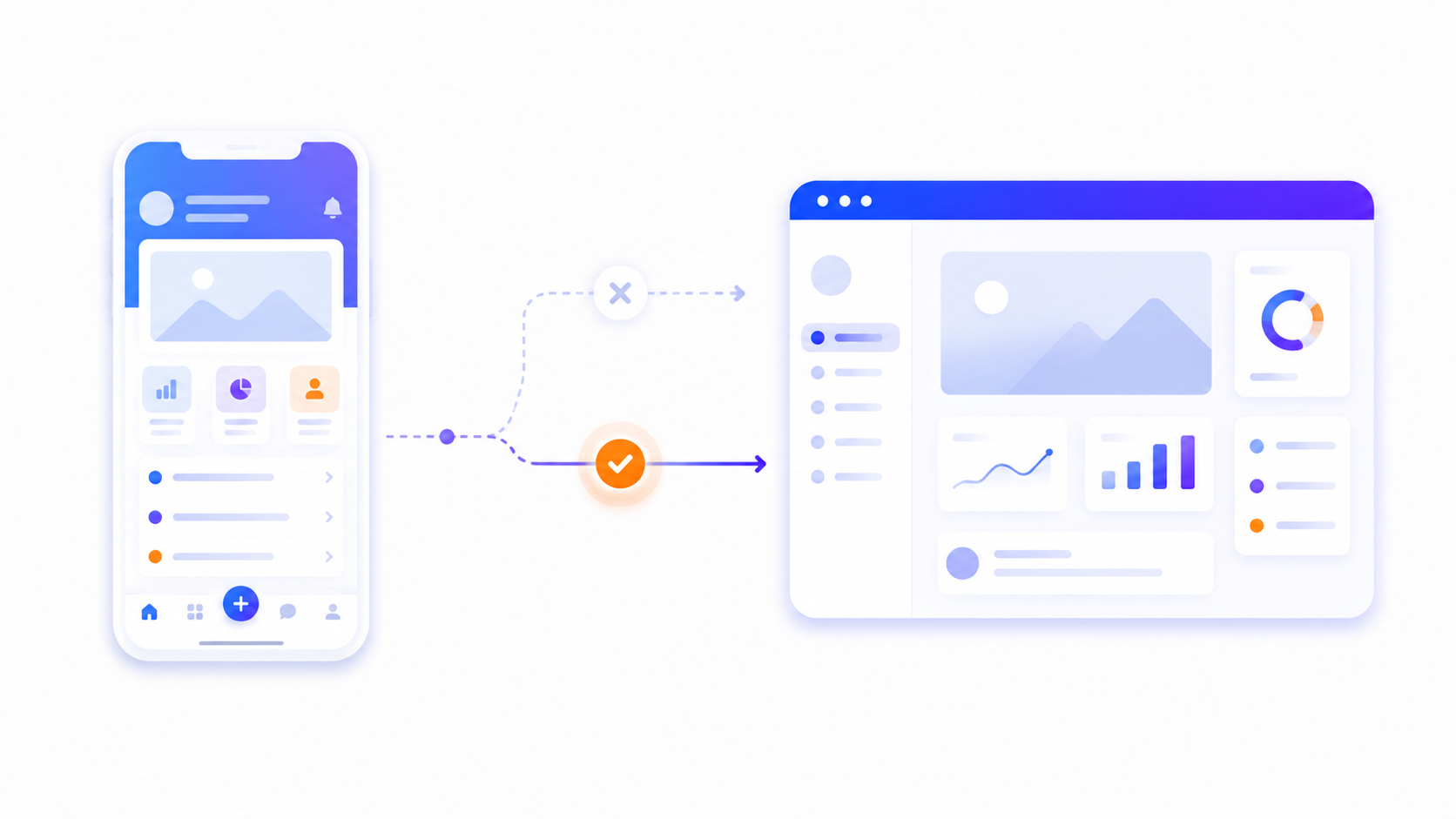
A native app is software built specifically for one operating system (iOS or Android), installed from the App Store or Google Play, and run directly on the device. It has full access to the phone's capabilities: camera, GPS, push notifications, sensors, local storage.
A web app, on the other hand, runs in the browser. It requires no installation or download, works on any device with an internet connection, and updates automatically without the user having to do anything. This category also includes PWAs (Progressive Web Apps), which behave very similarly to native apps without going through app stores.
The difference is not purely technical. It is a difference in experience, distribution, and maintenance cost.
A native app makes sense when the product depends heavily on the device's capabilities or when the user experience is a critical factor for the business.
When you need advanced access to camera, sensors, Bluetooth, background geolocation, or offline storage.
When push notifications are a core part of the retention strategy.
When interface speed and smoothness are decisive (games, editing apps, apps with complex animations).
When the business model depends on visibility in the app stores.
When usage is intensive and recurring, and users expect an experience on par with the best apps on the market.
Typical examples: fitness apps with background activity tracking, delivery apps with constant geolocation, banking apps, messaging apps.
A web app is the right option when the goal is to validate an idea quickly, reach as many users as possible with zero installation friction, or manage a business process that does not depend on the phone's hardware.
When you want to launch fast and validate the business hypothesis before investing in native development.
When access to device features is not critical.
When you need the product to work the same way on mobile, tablet, and desktop without maintaining two separate codebases.
When the initial budget is limited and reaching the market quickly is the priority.
When it is an admin panel, a B2B SaaS, or an internal tool where being installed from a store adds no real value.
Typical examples: admin dashboards, B2B SaaS products, booking platforms, marketplaces still in the validation phase, internal management tools.
A native app usually takes longer to build because, if you want to be on both iOS and Android, you are effectively building two products with separate codebases — unless you use a cross-platform framework like Flutter, which reduces but does not eliminate this duplication. That translates into more development hours, more testing, and a store submission process that adds external review time.
A web app or PWA starts from a single codebase that works on any device with a browser. Initial development is usually faster and cheaper, and updates go live instantly, without waiting on approval from Apple or Google.
As a general reference, a well-scoped web or mobile MVP typically starts around 3,000€, while a complex platform with advanced logic, integrations, and specific scalability needs starts at higher figures. The final range always depends on the actual scope of the project, not on the technology itself.
Choosing native "because it looks better": if the business does not actually need it, that budget goes toward something that provides no real competitive advantage.
Choosing a web app purely to save money, without assessing whether the product needs device features: this can force a rebuild months later.
Not planning for growth: a product that starts as a web app and will need native features within 12 months should be designed with that evolution in mind from day one.
Copying a competitor's decision without analyzing your own case: what works for another business is not necessarily right for yours.
Before deciding, it helps to answer these questions:
Does your product depend on device features (camera, background GPS, push notifications, sensors)?
Do you need to be present in the app stores for visibility or brand trust reasons?
What is your priority right now: validating quickly or building the definitive experience?
What budget and timeline are available at this stage of the project?
Who is your user, and how do they expect to access the product?
With clear answers to those questions, the decision is usually far more obvious than it seemed at first.
There is no absolute best option. There is the right option for your specific case, at the specific stage your business is in. A native app delivers performance and full device access; a web app delivers speed to market and lower maintenance cost.
This decision should not be made on intuition or by copying a competitor, but through an honest analysis of what your product actually needs.
Tell us what you need and we will help you decide the right path for your project.
Generally yes, since it involves building and maintaining separate code for iOS and Android. The final cost depends on project scope, not just the technology type.
Yes, it's a common strategy: validate the product with a web app or PWA, then evolve to native once the business justifies it.
A PWA is a web app that can be "installed" on a phone and works offline in a limited way, but it doesn't go through app stores or get full access to device hardware.
It offers a very similar experience in most cases, but it doesn't match native performance or access to advanced device features under heavy use.
It depends on whether your product needs device features, your launch priority, and your budget. An upfront technical analysis prevents choosing wrong from the start.
Our clients' satisfaction is our best introduction.
"Tengo un negocio de Paquetería, en el que vienen muchas personas diariamente, tanto para recoger como para dejar paquetes. Llevábamos años gestionando muchos de nuestros procesos de paquetería de forma manual, y gracias a Blimbur Technologies hemos dado un salto enorme. Nos desarrollaron una app móvil y una web totalmente adaptadas a nuestro flujo de trabajo, con las que ahora tenemos todo automatizado, trazable y mucho más rápido. Ahora, el cliente sabe si tenemos el paquete y al estar todo mucho más organizado, es mucho más rápido y ágil, lo que hace que los clientes vengan y se vayan con otra cara y sin esperas. El trato ha sido impecable y el resultado, todavía mejor. Un equipo serio, técnico y que se implica de verdad."